
Desks and workspaces
Desks, tables and chairs damp wiped, sills and fittings dusted, and touchpoints sanitised. Personal items are worked around, not moved.
Office cleaning
Cleaning for occupied offices, run from a written plan. Your team works to a fixed daily order, detail tasks have a set day each week, and standards are written down so an inspection has something to measure against.

Typical scope
The real scope is set by your site plan after a survey, because a single floor and a four-storey building do not need the same thing. This is what a typical office contract includes.
Daily
Every Acies shift follows the same nine steps in the same order. Each one ends by checking the work before moving on, which is what stops the last room of a shift looking different from the first.
Lights and ventilation on, caution signage out, and a look at the state of the space before anything is touched — bins, kitchen, general appearance, stock levels.
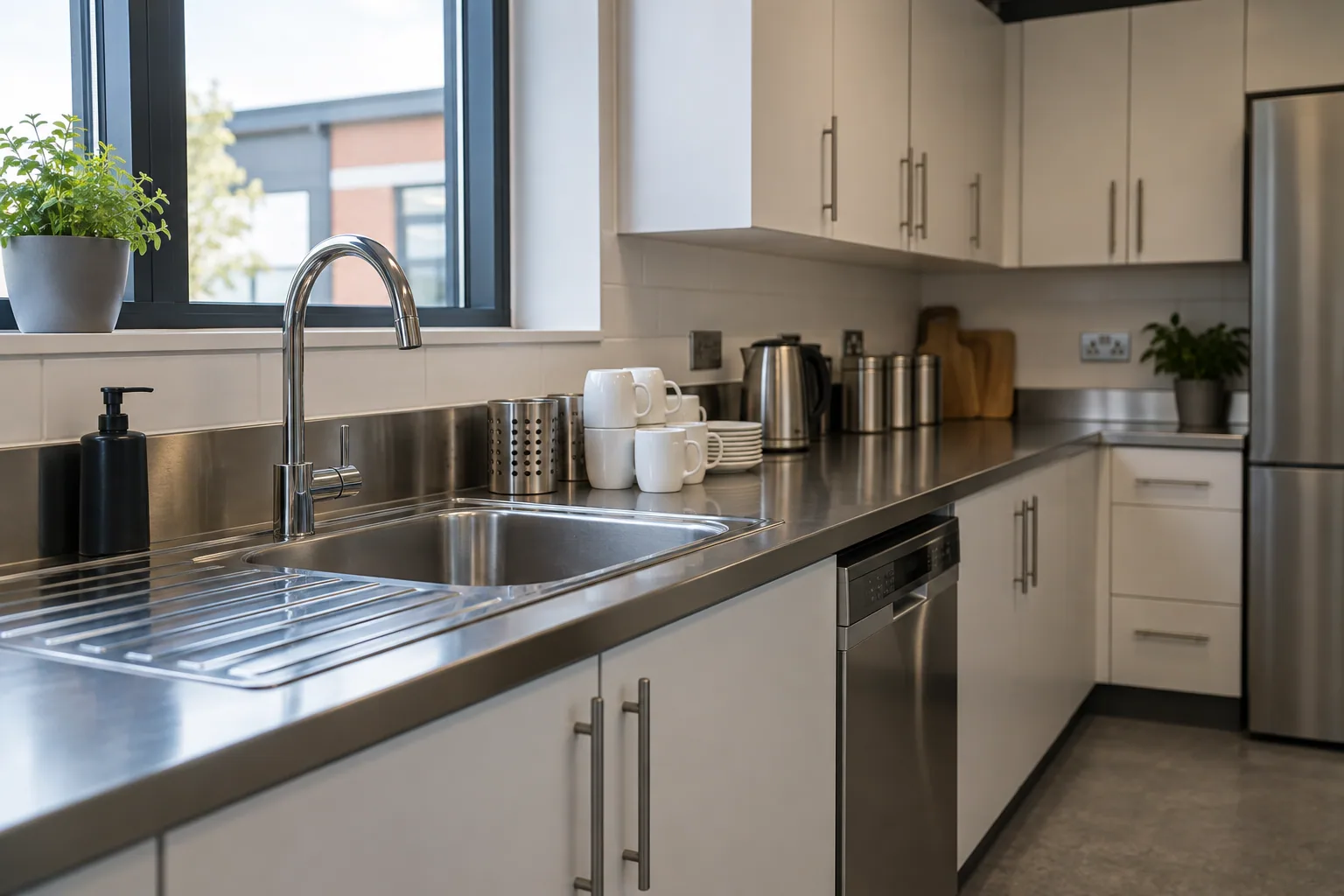
Crockery washed and put away, appliances and surfaces damp wiped including underneath, cupboards left ordered.
Desks, tables and chairs damp wiped, sills and fittings dusted, glass and handles cleaned, and every touchpoint sanitised.
Ventilated and signed, consumables replenished, then cleaned top to bottom and cleanest to dirtiest, finishing with the floor.
Every stream to the right bin, bins themselves wiped, and the area under and around them cleaned rather than stepped over.
Under desks and furniture, into corners and edges, and across entrance matting — the places a quick pass misses.
All hard floors, left free of removable marks rather than simply wet.
Hard floors cleaned with a scrubber dryer on a weekly cycle, which is what stops a mopped floor slowly greying over a year.
The space set back to how it should look on arrival, anything to report written down, equipment cleaned, and the building left secure.
Weekly
Most contracts promise periodic cleaning "as required", which is how descaling, dusting and cobwebbing quietly stop happening. Acies gives each theme a fixed day of the week, so the detail work is part of the routine rather than something to catch up on.
Monday
Tuesday
Wednesday
Thursday
Friday
The exact tasks on each day are set by your site plan. This is the shape of it, not a fixed list.
The standard
Acies specifies the result rather than the activity. "Mopped the floor" is an activity and proves nothing. The table below is what both sides measure against at an inspection — including what is reasonable to see between cleans, because a building in use is not a photograph.
| Area | Acceptable on completion | Acceptable between cleans | Unacceptable |
|---|---|---|---|
| Hard floors | Dry, uniform in appearance, and free from spillages, removable stains, superficial marks and loose debris. | Debris and spillages arising from normal use since the last clean. | Build-up of spillages, removable stains, scuff marks or debris. A non-uniform finish. |
| Soft floors | Free from visible loose debris, dust, fluff and lint, with an overall even appearance. | Debris arising from normal use since the last clean. | Build-up of debris, dust or lint, particularly around edges and the bases of furniture. |
| Vertical and high-level surfaces | Free from impacted debris, dust, cobwebs and removable marks. | Dust and marks arising from normal use since the last clean. | Build-up of dust or impacted debris, especially where vertical surfaces meet horizontal ones. |
| Furniture, fixtures and fittings | Dry, uniform in appearance, and free from impacted debris, dust, cobwebs and removable stains. | Debris, dust and marks arising from normal use since the last clean. | Build-up of dust or impacted debris. Removable stains and smears. |
| Sanitary fittings | Dry, odour free, uniform in appearance, and free from impacted debris, removable stains, scale and body fats. | Debris and residual odour arising from normal use since the last clean. | Build-up of impacted debris, fats or scale on any surface. Removable stains and smears. |
Why it holds up
An office contract does not usually fail in week one. It fails around month four, when the detail work quietly stops and nobody notices until a complaint arrives.
A site survey takes about an hour. You get a task-and-frequency plan for your building, and it is yours to keep whether or not you go on to work with Acies.